

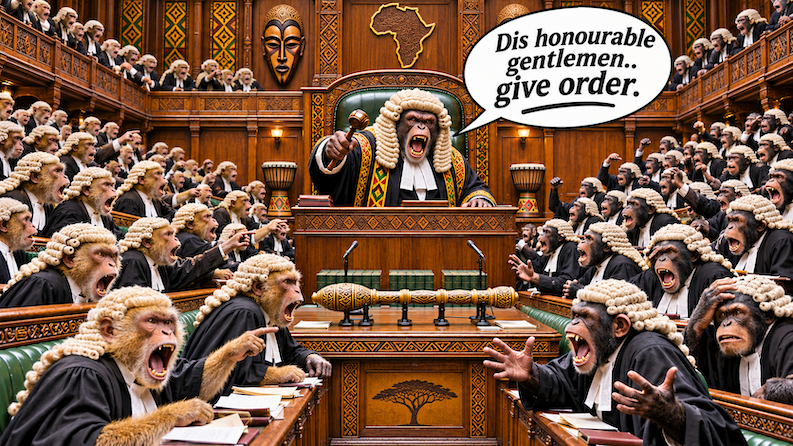

THE INDEPENDENCE DECEPTION: WHAT HAPPENED TO THE PROMISE?
A Parliament of Political Absurdities
Where everybody is honourable, nobody is accountable, and the public always pays the bill.
Over the decades, I have watched former colonised nations across the world emerge from colonial rule and acquire their independence. Yet, many appear to have struggled with a fundamental question: Who are we, and what exactly do we intend to become? Independence was supposed to represent liberation, self-determination, economic emancipation and the opportunity to build prosperous societies on the foundations of their own resources, cultures and aspirations. Instead, in far too many instances, what we have witnessed is an extraordinary contradiction.
Many former colonies have inherited Western political institutions, religious traditions and social conventions, embracing certain aspects of European culture with an enthusiasm that sometimes surpasses that of the Europeans themselves. Yet, the most important elements of responsible governance, institutional integrity, accountability and economic discipline appear to have been lost somewhere along the journey. I watch, sometimes with genuine embarrassment, as political establishments across parts of Africa go to extraordinary lengths to imitate the ceremonial grandeur and parliamentary traditions of their former colonial masters. The elaborate parliamentary chambers, the imposing robes, the wigs, the grand titles, the presidential entourages and the endless pomp and ceremony are all there. But one has to ask a rather uncomfortable question:
What exactly is happening behind all that theatrical grandeur? Where is the substance of governance? Where is the accountability? Where is the economic transformation that independence was supposed to deliver? There is a cruel irony in the fact that some of the very societies blessed with extraordinary natural wealth continue to struggle with poverty, hunger and inadequate infrastructure. I have often described this phenomenon as BABOON ECONOMICS. Consider the contradictions. We possess enormous mineral wealth, yet our populations remain desperately poor. We have vast expanses of fertile agricultural land, yet we import food while millions struggle to feed their families. We have timber resources, yet rather than developing substantial domestic manufacturing industries, we export raw materials and subsequently import finished products at several times their original value. We aspire to drive the finest German automobiles, yet in many places the roads upon which these vehicles must travel remain in appalling condition. We boast about our natural resources, but fail to develop the industrial capacity, infrastructure and technological expertise required to turn those resources into national prosperity. The contradictions are endless. And who ultimately pays the price? The ordinary citizen.
THE INDEPENDENCE THAT NEVER QUITE ARRIVED, Let us also consider the political and institutional structures inherited from colonial rule. Many colonial-era borders remain in place, often dividing communities and ethnic groups according to boundaries drawn for administrative convenience rather than the realities of historical, cultural and geographical relationships. Yet, decades after independence, meaningful regional integration and cooperation remain unfinished ambitions. The development of strong, independent institutions has also been neglected in too many countries.
Education budgets are squeezed, public infrastructure deteriorates, hospitals struggle to provide basic services, and essential public facilities are allowed to descend into conditions that should embarrass any government claiming to represent a modern state. Meanwhile, allegations of corruption, public procurement irregularities and the diversion of public resources continue to feature prominently in political life. The security apparatus, which should exist to protect the citizenry, is in some countries accused of behaving as though it exists above the law. There are disturbing reports of police brutality, extrajudicial killings and the violent suppression of peaceful demonstrations. Citizens who take to the streets demanding better governance, transparency and accountability should not have to fear being shot, beaten or imprisoned for exercising their fundamental rights. A government that fears its own citizens has fundamentally misunderstood the purpose of public office.
And then we arrive at the very institution that should be holding the executive accountable: Parliament. What should be a serious institution of democratic scrutiny and public representation has, in some countries, become an arena of political theatre, and a Parliamentary circus. Members of Parliament exchange insults, engage in theatrical confrontations, defend political patrons and, on occasion, appear more interested in protecting their positions than representing the people who elected them. Accountability becomes selective. Political loyalty takes precedence over national interest. In certain political establishments, the presidency itself appears to have become a family inheritance rather than a public responsibility.
The country’s resources are treated as though they belong to the ruling establishment, while the possibility of transferring political power to sons, daughters or other family members becomes an extension of the political conversation. Nepotism, tribal loyalties and political patronage further undermine the development of genuinely national institutions. And through it all, the ordinary citizen is expected to remain patient.
How much patience can a population reasonably be expected to exercise while its wealth is extracted, its institutions deteriorate and its children are denied opportunities? THE QUESTION WE MUST ASK. Independence was never supposed to be an elaborate costume change, with colonial administrators replaced by local political elites who simply inherited the machinery of power. It was supposed to be about something far more profound. It was supposed to be about dignity, responsibility, self-reliance, economic development and the right of ordinary people to determine their own future. Instead, in too many instances, we appear to have perfected the art of reproducing the outward appearance of Western democracy without consistently delivering its essential obligations. And perhaps that is the greatest tragedy of all.
We have mastered the ceremonies of government, but have we mastered the responsibilities of governing?
Welcome to THE DISHONOURABLE HOUSE.
Where the wigs are immaculate, the parliamentary chambers are impressive, the speeches are magnificent, and the national accounts are mysteriously difficult to explain.
The Honourable Members are requested to take their seats. The Speaker would like to remind the House that accountability is not optional.


